Search This Blog

Translate

Saturday, 22 October 2016

Chameleon

The chameleon is a very well known species of lizard. They have long curly tail and large eyes. They are mostly found in forest parts of Africa and Asia. Some chameleons are able to change their color. 
Different chameleon species can change their color in patterns of pink, blue, red, orange, green, black, brown, light blue, yellow, turquoise, and purple. Chameleon skin has an outer layer which has pigment and under the layers are cell with guanine crystals. Chameleons can change their color by changing the amount of space between the crystals which then changes the wavelength of light reflected off the crystals, which changes the colors.
Color change in chameleons are to camouflage, but also commonly used in social signaling and in reactions to temperature and other conditions.Chameleons show brighter colors when are being dangerous to other chameleons,and darker colors when they give up.
 
A Chameleons feeding mechanism is very unique.They usually eat insects. They feed by projecting their long sticky from their mouth to the insect which a distance away. Tongue projection or shooting occurs in as low as 0.07 seconds.

Chameleon's eye are also very amazing. Each eye can pivot and focus .The eyes can move freely allowing the chameleon to focus at  two things at the same time. The eye also have 360 vision.

Monday, 25 July 2016

Ring tailed Lemur

Map of Madagascar, off the southeast coast of Africa, with a range covering most of the southwest portion of the island.This species of lemur is mainly recognized by the rings on the tail. It is considered to be one most intelligent primates as it has skills of using tools and problem solving.

 They are able hunt food in day or night.They do stay very close to each other though when it is time for resting. They are going to be found alone for finding food though with the exception of mothers and the young.They also give of high pitched alerts to their families when there are threats around the area.They also spend the most time on land than any other species of Lemurs. Yet they do very well in the trees as well.
They eat fruit, which makes up the greater part of their diet, but also eat leaves, flowers, tree bark, and sap. The live on island of Madagascar of the coast of Africa. Its main predator is Fossa.
 
 
Image result for african ring tailed lemur

Monday, 27 June 2016

Caracal

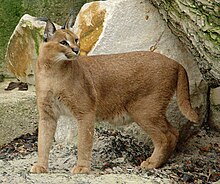
Caracl (01), Paris, décembre 2013.jpg
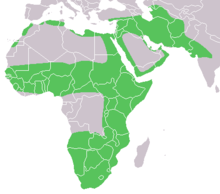
Caracal distribution.pngCaracal is a medium sized wild cat living in Africa, it is commonly known as the African Lynx. It is related to  the Serval. The name Caracal comes from a turkish word which means black ear.It has highly sensitive hearing as it is nocturnal. It reaches 40- 50 cm and can weigh 8-18 kg.
Although it is small, it is able to outrun and overpower ostriches which is the largest bird on earth. The caracal is highly secretive and territorial and is also solitary.
The carcal has unique hunting techniques. It can catch prey by leaping into the air and catching the birds in midair.
 

Monday, 28 December 2015

Bonobo

Bonobo at Cincinnati ZooThe bonobo is a large species of primate that is only found in the Democratic Republic Of The Congo in central Africa. The bonobo is also known as the pygmy chimpanzee and the dwarf chimpanzee as the bonobo is thought to be very closely related to the chimpanzee and the two animals share very similar features. The bonobo is smaller than the chimpanzee with adult bonobos averaging around 70cm in height and weight about 40kg, The bonobo has black hair covering it's body that is parted on it's head, pink lips and long legs. Generally, the body of the bonobo is not as hairy as the body of their chimp cousins. 
Head of a Bonobo (Pan paniscus)The bonobo is an omnivorous animal mainly feeding on vegetation such as fruits, leaves, flowers, bark and seeds. The bonobo also eats honey, eggs, insects and even small mammals and reptiles.
 Today, the bonobo is thought to be an endangered animal with only 10,000 bonobo individuals considered to be left in the wild. The bonobo populations have lowered significantly due to hunting and habitat loss.

Facts
 Scientific Name :      Pan Paniscus
Other names :            pygmy chimpanzee, dwark chimpanzee
Biggest threat :          hunting and habitat loss
Predators :                 crocodiles, human
Food :                         Fruit, Leaves, Seeds, Insects
Diet :                           omnivore
Life span :                  30-40 yrs
Size:                           73 cm- 90cm
Weight :                      55 to 110 lbs (25 to 50 kg)         
 Range :                      Central Africa 
 Habitat :                     Lowland jungle and swamp forests

Sunday, 27 December 2015

Bongo


Bongo in Africa Animal Area of Taipei Zoo
The Bongo is a large species of antelope that is found inhabiting the jungles and forests of Eastern, Western and Central Africa.They are the largest animals living in forests.The Bongo is a large and heavy-bodied antelope with a short chestnut colored coat that is darker on the bottom side and patterned with between 10-15 vertical white stripes that help the Bongo to remain camouflaged in the jungle. There are two types of Bongos, the Mountain Bongo\the Eastern Bongo and the Lowland Bongo\the Western Bongo.bongos are preyed by leopards, lions, hyenas and pythons.Bongos feed on leaves, roots, bark and grasses at night to keep them safer from the other predators that they share their habitats with. The Bongo has a tongue that is able to wrap itself and take hold of things which helps it to reach fresh leaves higher up and also helps it when pulling roots out of the ground. Both species of Bongo are threatened by both hunting and habitat loss with populations having declined significantly as although it still has a relatively wide distribution, populations are becoming more and more isolated.

Sunday, 22 November 2015

Black Rhinocerous

Black Rhinoceros (Diceros bicornis) at Ngorongoro Conservation Area, TanzaniaThe black rhinoceros (also known as the hook-lipped rhinoceros) is a large species of rhinoceros native to Africa. Despite it's name, the black rhinoceros is actually fairly light in color with most black rhinoceros individuals having either white or grey skin.The black rhinoceros is one of the larger rhinoceros species with the horns of the black rhinoceros known to reach 1.5 meters in length. The black rhinoceros uses it's horns are used for defense, intimidation, digging up roots and breaking branches during feeding.

barn owl


OwletsA Barn OwlBarn owls are one of the most widely distributed birds found everywhere around the world except from the polar and desert regions. Although this is the case, the barn owl population is more found in the Southern Hemisphere due to better climate conditions for the barn owl.
Barn owls  measure between 25 and 40cm tall and adult barn owls can have a wingspan of up to 110cm long. 
Barn owls commonly hunt small mammals such as mice, voles and rats, but barn owls also hunt fish close to the surface of the water and smaller birds in the tree tops and even in the air.
There are more than 30 different species of barn owl found across Europe, Africa, Asia and parts of Australia and the Americas. All barn owl species have a similar appearance but can differ great in both size and color.

Friday, 25 September 2015

Baboons

Papio anubis (Olive or Anubis Baboon)
The Baboon is a medium to large sized species of Old World Monkeys that are found in a variety of different habitats throughout Africa and in parts of Arabia. The five different species of Baboons are the Olive Baboon, the Guinea Baboon, the Chacma Baboon, the Yellow Baboon and the Hamadryas Baboon. Baboons are very sociable and intelligent animals. They are also very adaptable animals. The Olive Baboon is the most widespread species with a range that extends from west to east across a wide range of habitats.
Baboon in Ghana
The Baboon is an omnivorous animal that is mean it eat a wide variety of both plant and small animals. Their diet consists of fruits, seeds, tough roots, flowers, insects, eggs, lizards and rodents.  Baboons have very similar teeth to people with a series of large, flat molars which are used for grinding down plant matter. More food can be stored in their flexible cheek pouches to be saved for later.Baboons can even travel more than 4 miles a day!


Friday, 11 September 2015

Aye Aye

Aye-Aye (Daubentonia madagascariensis)
The Aye Aye is a species of Lemur that is found inhabiting the rainforests of Madagascar. The Aye Aye is not only the largest nocturnal primate in the world but is also one of the most unique and strangest animals. Although today population numbers seem to have risen, the Aye Aye is one of Madagascar's most endangered animal species.
The Aye Aye is a nocturnal and arboreal animal meaning that it spends most of it's life high in the trees. Although they are known to come down to the ground on occasion. During the day Aye Ayes sleep in nests  of tree branches that are made out of leaves, branches and vines, wake up at night to begin their hunt for food. Male Aye Ayes also share their territories with other males!

Sunday, 12 July 2015

African Wild dog

African Wild Dogs - Kruger National Park - South Africa (Sabi Sabi Game Reserve)African Wild Dog (Lycaon pictus)The African Wild Dog (also known as the Painted Dog and the Cape Hunting Dog) is a medium sized species of canine found across sub-Saharan Africa. The African Wild Dog is one of the the most social canines, living in packs of around 30 individuals.The fur of the African Wild Dog is red, black, white, brown and yellow in color with the random pattern of colours being unique to each individual. It acts as a type of camouflage, helping the African Wild Dog to blend into it's surroundings. A pack of wild dogs are an elite team, they do everything as a group, from hunting for and sharing food, to helping sick members and assisting in raising young. African Wild Dogs communicate between one another through touch, movement and sound. Pack members are incredibly close, gathering together before a hunt to lick each other, whilst wagging their tails and making high-pitched noises.Sadly however, this animal is severely under threat in much of it's natural habitat, primarily due to habitat loss and having been hunted by Humans.

Thursday, 16 April 2015

African Tree Toad

African Tree Toad
African Tree ToadThe African Tree Toad (Nectophryne afra) is a small species of toads found in the forests of Central Africa.The Toad has specially designed feet for it's semi-aquatic and tree climbing lifestyle.The African Tree Toad is a terrestrial animal and uses it' s toes to also help it to hop on the ground.The toes of the African Tree Toad are long and thin, with sticky, round discs on the tips.The small striped body of the African Tree Toad grows up to 3.8cm in length making these animals hard to spot on the forest floor.
the African Tree Toad spends much of it's life walking, hopping or running on the ground where it can find food and water. When it is night time, the African Tree Toad goes to high ground vegetation to remain safe at night from other predators.The color and stripes of their skin, gives the African Tree Toad camouflage against  hungry predators.
Classification
Image result for frog icon
Kingdom:Animalia
Phylum:Chordata
Class:Amphibia
Order:Anura
Family:Bufonidae
Genus:Nectophryne

Facts
 Scientific Name :       Nectophryne afra
Speed :                         8km/h (5mph)
Biggest threat :           Water Pollution, Habitat Loss
Predators :                  Snakes, Lizard, Toad, Fish, Birds
Food :                          insects, worms, snails and small invertebrates
Diet :                             carnivore
Life span :                    3-5 years
 Lenght :                      2.8cm - 3.5cm (1in - 1.5in)
Weight :                       2-5g      
 Range :                      Central Africa 
 Habitat :                    Tropical Lowland Forests 

Monday, 14 July 2014

African Penguin


African penguins Boulder Bay 1.jpg
Jackass Penguin.png
African Penguins, (Spheniscus demersus) is of the penguin species. It is also known as black-footed penguin or jackass penguins. Adults weighs  2.2- 3.5 kg.    

Kingdom:Animalia
Phylum:Chordata
Class:Aves
Order:Sphenisciformes
Family:Spheniscidae
Genus:Spheniscus
Scientific Name:Spheniscus demersus


Facts
 Scientific Name :        Spheniscus demersus  
Other names :          black-footed penguin, jackass penguin 
Biggest threat :            Habitat disruption
Predators :                   Sharks,Gulls and Fur seals
Food :                         . Fish and Squid
Diet :                            Carnivore
Life span :                   10-15 years
  Height :                      60cm -68cm(24-27 inches)
Weight :                       2kg - 5kg (4.4lbs - 11lbs)         
 Range :                      south-west African coast
 Habitat :                      Rocky Ocean Islands
Conservation Status:  Endangered
 

Wednesday, 9 July 2014

African clawed frog


An African Clawed Frog (Xenopus laevis)
The African clawed frog, an aquatic, fierce, scavenging predator frog. Their color makes them camouflage from hungry predators. They are good at surviving in various habitats. Sometimes they are mistaken by people for African dwarf frogs. .    

Classification
Kingdom:Animalia
Phylum:Chordata
Class:Amphibia
Order:Anura
Family:Pipidae
Genus:Xenopus
Facts
 Scientific Name :       Xenopus laevis
Other names :             platanna  
Speed :                         8km/h (5mph)
Biggest threat :           Water Pollution
Predators :                  Snake
Food :                          fish, water bugs, spider and small invertebrates
Diet :                             carnivore
Life span :                   8- 15 years
 Lenght :                      2.5cm - 12cm (1in - 5in)
Weight :                       25g - 220g (1oz - 8oz)         
 Range :                      eastern and southern Africa 
 Habitat :                    Warm stagnant water with grassland